 Going live, staying alive -
Dr. Nelken on Kaiser and Epic October 4, 2025 - Dr. Nicolas Nelken is a highly accomplished and awarded surgeon at Hawaii Kaiser. He is director of its vascular surgery unit. Like me, he is a graduate of both UCSC and UCSF. Over the years since graduation, we have maintained our friendship. In the last two decades, Dr. Nelken's work has overlapped my own professional focus on the electronic health record (EHR). Specifically, Dr. Nelken was "pivotal" [source: Muraena] on the team that implemented Epic at Kaiser in Hawaii. This was the topic of our 10/4/25 interview. Dan: Please describe Hawaii Kaiser's transition to Epic's electronic health record.
N: Yes. Even then, Kaiser was highly politicized. There is a storied history of high-stakes negotiations between Kaiser, Permanente, and Kaiser Foundation. Kaiser is the insurance company. Permanente Medical Group is the doctors, responsible for safety. The third is the Kaiser Foundation that owns and operates the hospitals, hires the nurses, and runs the infrastructure. Highly consequential meetings in the late 50s did succeed in getting consensus in a Memorandum of Understanding that enabled the work to proceed. D: Tell me more about Kaiser. N: I describe it as a large, benign company for the benefit of patients. It is evidence-based. It gives fair payment to its workers. The institutional culture is full of wonderful, interesting ideas and decision-making is by consensus. In my opinion, egalitarianism like this can make it too easy for good ideas to be sidelined. It is said, "That is the bad joke about Kaiser." Fortunately, electronic medical records have survived this process. D: How did this play out in the transition to Epic? N: An early decision that in hindsight has proven unfortunate regards what Epic calls instances. "An Epic instance [is] a specific deployment of Epic... software that is tailored for a particular healthcare organization. Each instance operates independently, allowing the organization to manage its own patient data and workflows." [Source: Digitalhealth]. Since Kaiser sites operate with much autonomy, their individual data-keeping requirements were deemed too diverse to be supported by a common data structure. Hence, each deployed a unique instance, 24 in all. There were three in Southern California, four in Northern California, etc. Later, they discovered that interoperability - data-sharing between sites - was difficult and, in some situations, even impossible. Hawaii has spent more than five years trying to join up with Southern California and it is not working yet. To avoid these issues, Epic offers Care Everywhere, a shared data structure (based on industry standards including one named FHIR) that enables different instances to share data. In a meeting with Kaiser leadership, Judy urged Kaiser to forsake the existing nightmarish system and start over with Care Everywhere. Kaiser's Epic team declined. Epic opposed this decision. I call it the cockroach that roared. I asked, would you suggest we do this bit by bit or in a big bang? My question won me no friends; the elephant in the room was Kaiser's vast investment, too vast to abandon. Opting for fiscal prudence over clinical data visibility, Kaiser management stuck with its heterogenous data structures. Rarely shared with customers is a 1-to-10 customer-rating scale used informally by Epic staff: how "EPICized" are you (i.e. how well have you implemented it?) In that meeting, Judy said, Stanford's a 7. Kaiser's a 1. Yet, heterogeneity was Kaiser's only viable option; repeating its $2B investment was not possible. We are paying for this compromise with a painful retrofitting process. These are bruises that trailblazers inevitably sustain and I remain proud of my employer. There are other valuable features, too, that Kaiser declined to implement. One is called Slicer Dicer (here is an introductory video). It enables people to poke around in the EHR data for research and other purposes. But Kaiser didn't build the data structure that would support it. The people running Epic at Kaiser have lots of big ideas but the hard part is implementation. It is proving more expensive than anyone ever imagined but in the long run it's worth it. We've muddled along but on balance it's the right way to go. D: Give another example of a challenge you dealt with in the process of building Epic at Kaiser. N: Here's a feature we should have accepted: a wound care module that was released by Epic in the mid-teens. In our implementation, it is hard to document wound data. For example, it is essential to record that that a wound is X cm wide by Y cm long by Z cm deep, a basic assessment for wound care management. In our instance, there were no fields for these items - they had to be entered as text in the wound care nurse's notes - so it was hard to follow a wound's progress [chart these data items over time; is the wound healing?]. The way we've implemented wound care data, busy wound care nurses often don't use because it's too hard and slow. It doesn't fit their workflow. This will eventually be remedied but there's no quick fix. Here's a lesson I learned the hard way: Whenever limited resources pit a clinical tool against a billing tool, the billing tool wins. D: That's true not only at Kaiser but everywhere. Charge capture is the single must important function of any EHR. N: Here's another, closer to my own clinical practice: despite a 15-year effort, I have been unable to get VQI (Vascular Quality Initiative) data to be tracked at Kaiser. VQI tracks in-hospital mortality and morbidity in the context of vascular surgery, my specialization. VQI follows each patient for a year after discharge. It would have contributed greatly to quality of care. But it would have required a separate database and Kaiser/Epic can't support that. In this case, the obstacle is Epic. I have been unable to convince Epic to incorporate these data fields. D: You mentioned that you have been to Wisconsin [corporate headquarters of Epic] several times. What formal training on Epic have you received? N: Actually, I have never had the time to receive formal Epic training. Even so, I have worked on many coding and documentation projects. Driving much of this is tremendous legal liability. For example, disputes over Medicare Advantage have sparked legal squabbles with industry giant United Healthcare. Our defense requires lots of data. For this, fortunately, Epic is an invaluable resource. D: EHRs are infamous for the burdens they add to the jobs of doctors and nurses. How have they impacted your people? N: It is burdensome but it's worth it, in my opinion. There is no unanimity on that. People lose sight of how much more information they have now compared to when we had only paper records. For example, before we had Epic, it would have demanded a substantial effort to retrieve an x-ray from five years ago. Today it's easy. It's undeniable that the burden is great. People were struggling after go-live in 2006. It's controversial what the benefit is. But I believe in the long-term mission. Better data supports better care. Back in the day, did we have the information we needed to save Mrs. Farber's leg? Who knows! But in 2025 it does save her leg. The benefit is real. My challenge is group dynamics and the amazing effort expended by the entire industry. It boils down to the value of effective management. Change is always hard. Especially change to workflow. D: How have patients, caregivers, and your institution benefited? N: Immensely. The downside - apart from the nuisance for the provider - is that it's so expensive. It takes money away from other important projects. Still, I can't imagine going back to paper records. Though (very occasionally) we have to. For example, during a power outage, or when a Russian trawler breaks the tie-line to the mainland, or there's a problem with Citrix (secure data communication and storage infrastructure). When we go to paper, it lasts up to eight hours and it's excruciating. For example, the clinical lab can no longer electronically record or report results and immediately becomes hammered when all the clinicians need them now.
N: Patients love it! D: My own point of view is that of a nursing informaticist. What are examples of EHR issues that Kaiser nurses have dealt with? How involved has nursing been? Have they had "a seat at the table", that is, participation in policy-setting and decision-making? I have heard that "if you're not at the table, you're on the menu." N: Not at Kaiser! Nursing has been extraordinarily well-represented in at least two ways: 1. Nurse administrators: hospitals hire a lot of them, more than doctor administrators. They are needed because floor nursing has a shelf life (high turnover) so management needs more involvement. 2. Nurses live in a "compliance culture." Epic and early cyber stuff is perfect for that culture. Doctors don't live in that culture; we focus on actual outcomes. D: What are your future career plans? N: I'm planning to join a dialysis company after my retirement from Kaiser which, after 22 years, will be in mid-2026. They, too, face some big data challenges that I look forward to tackling. D: Thank you for your time and congratulations on your remarkable career accomplishments in both surgery and data management. Clearly, you have more mountains to move. |
Dan Keller's Nursing, Health Policy & Healthcare Technology Blog
Nursing Informatics · Clinical Perspectives · Healthcare Systems

"The United States alone [among wealthy countries] treats health care as a commodity to be distributed according to the ability to pay rather than a social service to be distributed according to medical need." — JAMA (2003), 290, 798
 Nic: Epic at Kaiser was in its beginning stages in 1995. Kaiser's Northwest Region (based in Portland, OR) was an early adopter, deploying Epic in the 1990s. I was hired [at Hawaii Kaiser] on January 6th, 2003. Epic had gone live at its first Kaiser site in 2004. In my new job a couple of years after that, I went to Madison and Verona, WI to attend meetings with Epic staff and started using it. On two occasions, I met
 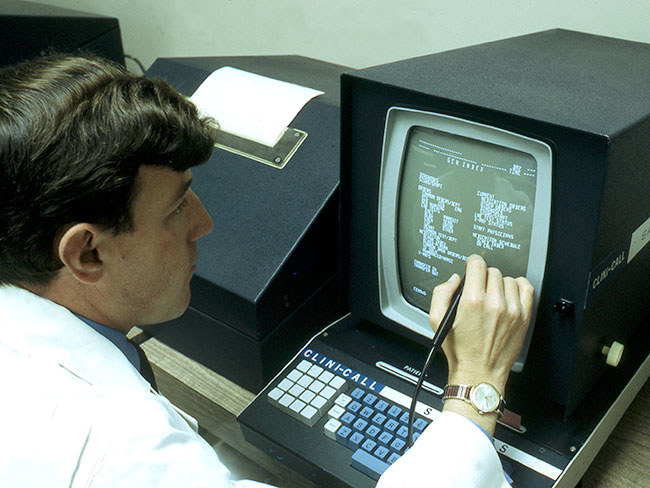 D: Yes! MUMPS (Massachusetts General Hospital Utility Multi-Programming System) was and is a brilliant, industry-leading technology. Hardly obsolete, in my opinion. Also industry-leading was Kaiser itself, with its ground-breaking - in 1961! - punched-card and light pen (photo at right) based electronic medical record named
 D: Part of the Epic system is a patient portal ("MyChart"). I have expressed