 Nursonomics
round 2 October 8, 2025 -- The economics of nursing has traditionally been problematic and remains so to this day. While nursing is essential to healthcare outcomes, it remains politically powerless because -- in the context of acute care hospitals -- it is not billable. For historic and convoluted reasons, billing for nursing service is not an option. Instead, its costs (mainly payroll) are bundled into acute care room rates. Hence nursing, the largest component of hospital budgets, is a cost center not a revenue center. Thanks to this bookkeeping quirk, nursing generates no revenue. Those who generate revenue wield power. I.e. not nurses. Thus, hospital management's incentive is to keep nursing costs as low as possible. One side effect: investments in nurses' education, training and work environment are scrimped. Nonetheless, it has been repeatedly shown that healthcare outcomes are directly related to quality of nursing care. Better nursing, healthier patients. Good nursing reduces complications and readmissions. Conversely, reduced investment in nursing means poorer outcomes for patients. How to fix this? Enter the Nursing Human Capital Value Model. As described in Becker's Clinical Leadership newsletter, it helps hospital and health system leaders to:
...quantify and communicate how investments in nursing directly contribute to improved patient outcomes, cost savings and sustainable financial performance.
...innovation requires providing nurses with some time to think, breathe, talk to colleagues, share hunches, and solve problems. This time should be recognized as productive time that could significantly increase value beyond what is currently possible with a short-staffed, burned-out nursing workforce. Compare this to today's typical "do more with less" experience of nursing work: never enough time or resources, perennially understaffed and highly stressed. How might the Economic Value of Nursing Model overcome this? It provides a framework for the financial numbers that demonstrate:
...investments in nurses' education, training, well-being, and work environment generate an ROI for organizations in terms of improved consumer/patient, nurse, societal, and organizational financial ROI. Built on Adam Smith's labor theory of value is, in the International Journal of Nursing Studies (Volume 160, December 2024, 104890) The Nursing Human Capital Value Model. In essence, "...the value of nursing should be viewed and measured from the return on investment (ROI) perspective, as the ROI in nursing human capital development, in terms of improved consumer, nurse, and organizational outcomes." Terminology:
Our profession is poised for this new financial paradigm. |
Dan Keller's Nursing, Health Policy & Healthcare Technology Blog
Nursing Informatics · Clinical Perspectives · Healthcare Systems

"The United States alone [among wealthy countries] treats health care as a commodity to be distributed according to the ability to pay rather than a social service to be distributed according to medical need." — JAMA (2003), 290, 798
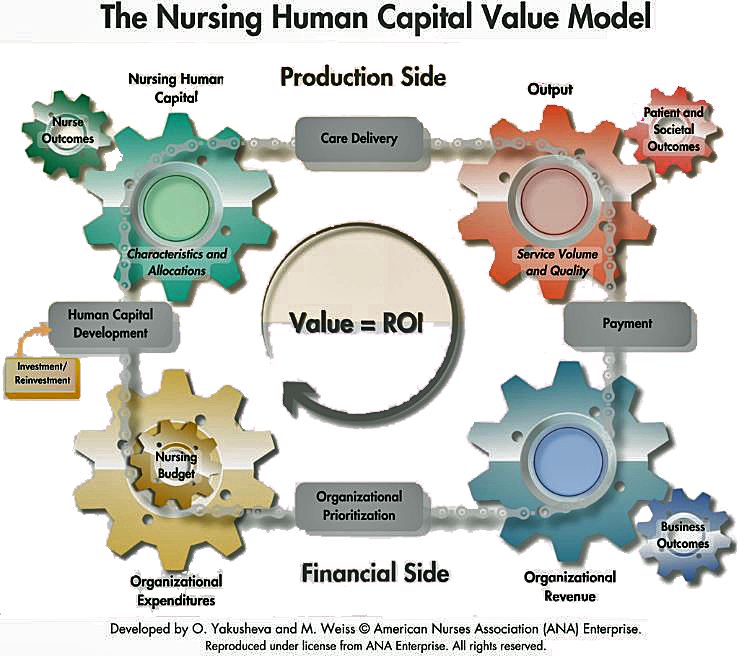 The model is presented in The Journal of Nursing Administration (JONA) September 2025 - Volume 55 - Issue 8: