 Measles --
no big deal?
October 3, 2025 --
Someone close to me recently observed that we all got measles when we were children and it was no big deal.
We went to bed for a few days and after that we were fine.
Therefore, she claims, banning or reducing measles immunizations doesn't really matter.
What's wrong with this opinion?
Why would such action actually cause a substantial public health threat?
-
That opinion displays a dangerous misunderstanding of both measles and public health.
-
Before there were vaccines, measles killed or disabled thousands, mostly children.
In the U.S., measles killed 400-500 and hospitalized 50,000 every year.
1 in 1,000 infected children in developed countries die from measles.
Imagine you're the parent of one and you'd declined to vaccinate.
-
Historically, in addition to fatalities, measles has caused deafness,
brain damage, pneumonia, encephalitis (seizures and brain damage) and blindness.
-
Measles is extremely contagious.
It is one of the most infectious viruses known.
It has a basic reproduction number (R0) of 12-18.
That is, one person can infect 12 to 18 others in a non-immune population.
By comparison, COVID's R0 is around 2.5; seasonal flu's is 1.3.
To protect ourselves from outbreaks, we require "herd immunity" of 95% or higher.
This is a fundamental concept of public health.
Herd immunity is especially important to babies under 12 months,
people with cancer, organ transplants, or immune disorders.
These people can't be vaccinated and rely on others for protection.
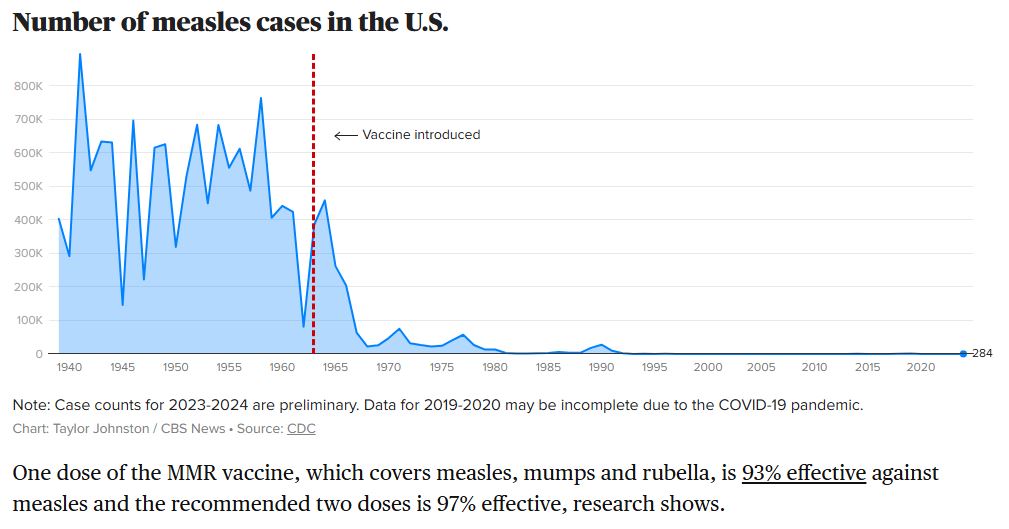 Before there was a vaccine, 4 million Americans got measles every year.
The vaccine became available in 1963.
Cases dropped by 99%.
Measles seems rare or mild now because vaccines have dramatically reduced the number of infections.
Our public health vaccine strategy has blessed us with our modern low rate of measles.
We must not take for granted this great success.
Before there was a vaccine, 4 million Americans got measles every year.
The vaccine became available in 1963.
Cases dropped by 99%.
Measles seems rare or mild now because vaccines have dramatically reduced the number of infections.
Our public health vaccine strategy has blessed us with our modern low rate of measles.
We must not take for granted this great success.
When vaccine rates dip, measles returns explosively.
This has been seen and documented in Ukraine, Samoa, and elsewhere.
Vaccination doesn't only reduce personal risk.
It's also for public safety.
Dismissing measles as a harmless childhood illness ignores history, science, and ethics.
It's "not a big deal" only when vaccination keeps it that way.
|
