It looks like an excellent study because you really do have to rely on
symptoms to distinguish different types of long covid (LC).
As they pointed out, routine labs were normal for almost everyone...
There are biomarkers for long covid, such as altered numbers and
function of various subtypes of T cells and levels of cytokines,
but those tests are pretty expensive and are not routinely done for most LC patients.
...The subtypes are useful ...treatments will be based on the subtypes.
...For symptoms like dizziness, you will use something like a beta blocker
to fix it. But my hope is that a necessary (perhaps not sufficient) factor to [diagnose] LC is active,
persistent replicating virus in your body (not in your nose or else you would be testing positive).
If they can kill the persistent virus, then all the symptoms may go away.
The exception would be if the virus caused permanent damage to some organs,
then you might still have residual problems.
The second big factor that is probably causal in LC is some kind of auto-immune condition
where the body's immune system is attacking the body. But if the virus is killed,
then the auto-immune could possibly slowly go away (I hope).
[Regarding the subtypes] it looks like:
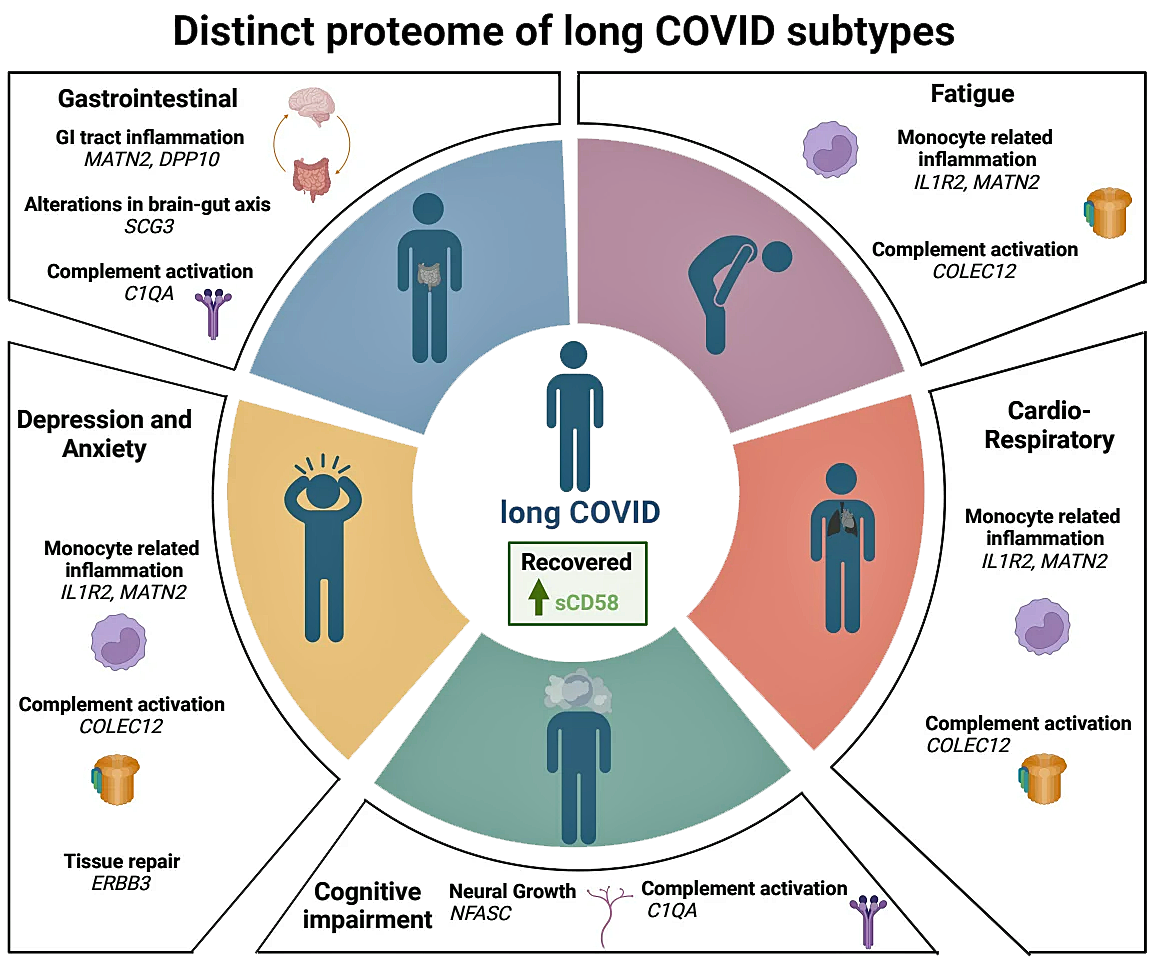
- Group 1 is mostly isolated damage to smell and taste.
Those are nerves close to your brain so they could represent
infection close to or in the brain. BTW, in acute covid,
smell and taste were messed up commonly (maybe 60%),
but it seems to be much less common in acute covid now.
- Group 2 is mainly involved in the lungs -- with the chronic cough.
That makes a difference in the supportive treatment like bronchodilators.
- Group 3 is mainly brain fog.
Many people are thinking of that as brain damage (though not necessarily permanent).
What they call brain fog is often more pronounced and specific than just "fog".
Like people lose some executive function and have trouble finding the right words. Scary.
- Group 4 focuses on people with palpitations, and looks like heart involvement.
LC can mess up the heart in a number of ways, including arrhythmias
(sometimes resulting in sudden death),
myocardial infarction, stroke, and I think heart failure.
- Group 5 looks like many organs are messed up.
The paper says these people got sick before Omicron,
so had a more severe LC, just as we know they tended
to have more severe acute covid.
The LC victims who post on Twitter, who are really sick,
often say they got sick around 2020, before Omicron.
[I hope the public gets] a sense from this study of how horrible this disease is.
Some fraction of LC patients can't continue working (maybe 25%?)
Some can't get out of bed for weeks. Some have muscle pain associated with all of this.
Heart, lungs, brain and blood vessels can be severely affected.
They can see shrinking of brain gray matter on MRI of about 7%, on average,
of patients who had acute covid, let alone long covid.
The risk of getting LC after acute covid is around 10% now,
and the risk grows by 10% with each acute covid infection.
 Long Covid: Worse than You Thought
