
UCSF's APeX Go-Live
June 8, 2012 --
APeX = Advancing Patient-Centered Excellence = UCSF's implementation
of the Epic electronic medical record.
A go-live is like changing the engines on an airplane in flight. Its
objectives are ambitious and important -- to free health workers and
providers from paper charts. The information flows that underlie
every step of every function are changed. The impacts on workflows
are ubiquitous and profound. In this vast complex of hospitals and
clinics, everyone's job is changing. Yet through it all, the beds
are occupied, lobbies and corridors are bustling, and labs,
pharmacies, radiology and imaging units are as busy as ever.
 Dr. Russ Cucina has been leading the preparations for this week for
a couple of years. His budget, he tells me, is $116 million -- small
change compared to the $2 billion Kaiser spent to convert to Epic --
yet a massive project nonetheless. Each implementation of Epic is so
unique that it is given its own name -- Kaiser's is HealthConnect,
UCSF's is APeX. For a nursing/medical informaticist, this week is
history in the making, not to be missed. The project is a remarkable
success and I have the good fortune to see it up close.
Dr. Russ Cucina has been leading the preparations for this week for
a couple of years. His budget, he tells me, is $116 million -- small
change compared to the $2 billion Kaiser spent to convert to Epic --
yet a massive project nonetheless. Each implementation of Epic is so
unique that it is given its own name -- Kaiser's is HealthConnect,
UCSF's is APeX. For a nursing/medical informaticist, this week is
history in the making, not to be missed. The project is a remarkable
success and I have the good fortune to see it up close.
During this week, I am enrolled in UCSF's School of Nursing's Summer
Academic Enrichment Program (SAEP), an upbeat introduction to its
advanced practice and research offerings. For me, the best part is
the clinical rotations, selected according to attendees' interest
areas. Mine was not in a nursing unit but in the Nursing Ops area of
the APeX go-live Command Center.
The Command Center has the staffing, technology, and aura of ground
control for a moon shot. Perhaps a military metaphor is even more
accurate, as it possesses a spectrum of clearly-defined job roles
and responsibilities in a complex hierarchy with logistics,
processes and procedures precisely scheduled. Dr. Cucina's team -- a
hundred people or more -- is focused and professional.
In my rotations, I shadowed a couple of the Informatics Nurse
Specialists (INS RNs) who performed a scout function, rounding from
one hospital unit to the next, checking in with the local "super
users" (nurses who had received special training in preparation for
deployment of the new system) to detect and report software and
process issues, and to confirm that fixes are "pushed out" and solve
problems as promised.
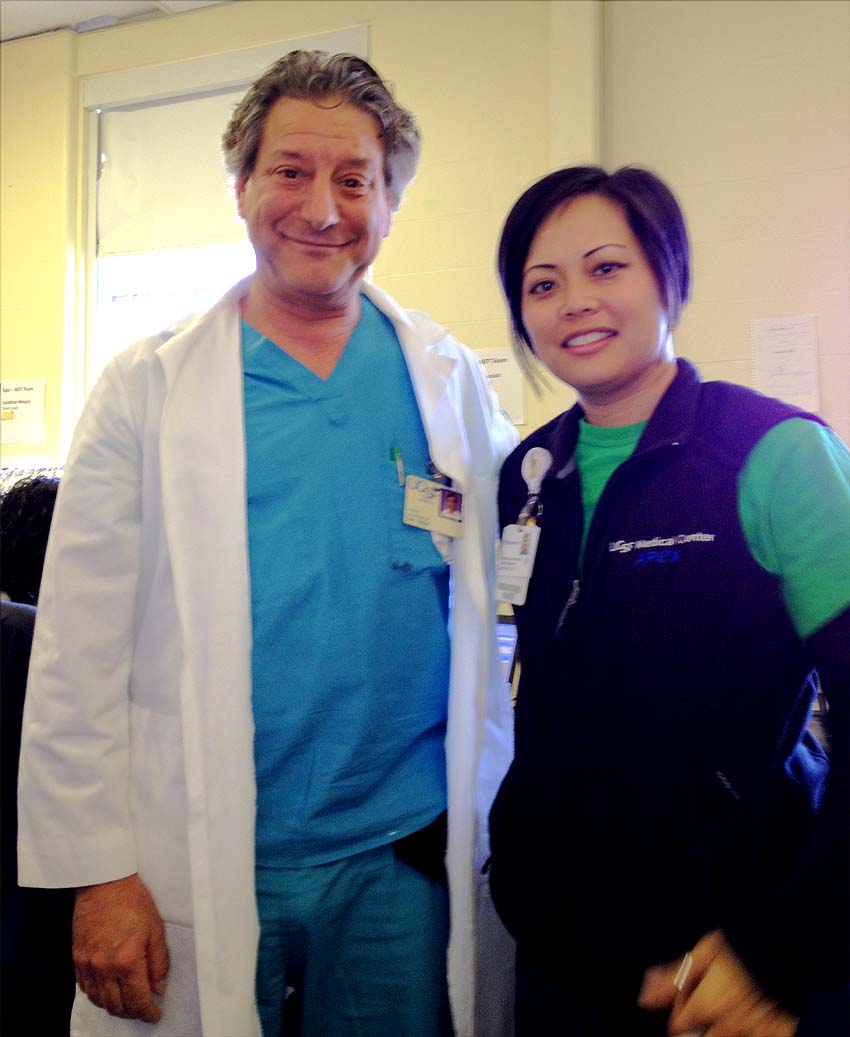
My INSs were Craig Johnson, RN, and Sandy Ng, RN (pictured here with
me). Brilliant and hard-working, they taught me a lot. Many thanks
to you both, and congratulations to UCSF on achieving a major
milestone!
Table of Contents
|
