 AI
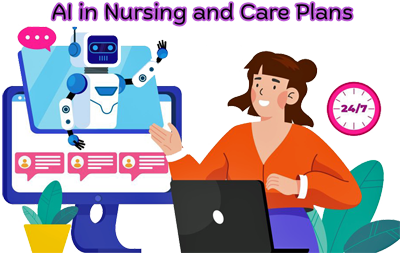
AIin nursing June 6, 2026 -- AI has come to nursing. Of course. Is that a good thing? Actually, yes. When well-planned, fitted carefully with workflows, AI is indeed beneficial. In this year-old article - Reimagining Nursing with Generative AI, we read of several ways in which AI has relieved some of the drudgery. The examples described here have been implemented in Epic for the Mercy chain of Catholic hospitals in the US Midwest. One successful application of AI is predictive analytics - risk assessment and notification. Patients at high risk for falls require additional safeguards. Assessing this risk is a task nurses do - repetitively but necessarily - at the start of each shift. Letting the computer do it (and being notified when the risk is high) is a welcome efficiency. Another is documentation automation. We nurses have long decried the amount of time we must spend in front of the computer instead of the patient. For example, writing care plans is a repetitive yet essential nursing task. To AI, some of that can be off-loaded. Typically done at the ends of shifts, this task can feel duplicative especially to nurses who have already thoroughly documented a patient's progress. AI-generated care plans are based on the goals identified at the beginning of the shift combined with flowsheet data, medication administrations, and lab results. AI writes the first draft of the care plan. The nurse then edits what AI wrote, applying clinical judgment and reviewing relevant details in the patient's chart. It's a real time-saver. Another AI-provided service that supports nurses is ambient voice recognition. Via a mobile device (and with consent, of course) AI records conversations in the room with the patient. It then translates the recording into flowsheet data that the nurse can review and file in Epic. Thus, essential documentation is produced automatically, saving nursing time. For implementing workflow streamlining such as these, Epic exhorts: AI is not a magic wand. If your nurses are documenting in a duplicative, pieced-together system, generative AI won't fix those problems; it will expose them. Start by reducing documentation burden for your nurses using resources made available through similar efforts by other Epic organizations. Don't wait for perfect conditions - take a step, measure impact, and iterate. Stay grounded in operational reality by ensuring that nurses have a seat at the table from day one. We say, amen! Illustration courtesy of Flowtrics. |
Dan Keller's Nursing, Health Policy & Healthcare Technology Blog
Nursing Informatics · Clinical Perspectives · Healthcare Systems

"The United States alone [among wealthy countries] treats health care as a commodity to be distributed according to the ability to pay rather than a social service to be distributed according to medical need." — JAMA (2003), 290, 798